
Thread Lightly (Insert Three Skull Emojis)
Featuring: School + Ideas + Formula 1 + Community.

As I quit social media, Zuckerberg spins up a new (sort of) social network for people to join.
A few weeks ago I turned my back on WhatsApp permanently, I’m currently in the process of exiting Twitter, and then Instagram, and so on and so forth. At the end of the day, you might only be able to find me on Substack and Warpcaster (but that’s invite only alas you poor pleb).
And yet, despite my best efforts at being chronically offline, I still saw the news that Instagram has launched Threads, a Twitter competitor. I don’t know how this new experiment will turn out but I am not inclined to believe that Zuck and his team have figured out a way of optimising a Twitter-like application for civil, intelligent discourse and not hot takes and mob behaviour.
We will see, but until then, here is what I want to share with you today.
School Is Not Enough
This essay is something along the line of something I firmly believe (and that my roommate and I were discussing just before I started writing this): Modern-day education does not give children meaningful childhoods.
Education is just something we have invented because kids need something to do while their parents are at work. It’s not designed to instil in children the skills necessary to navigate life well. Skills like curiosity, resourcefulness, and innovation are mostly beaten out by the systematic nature of education. In school, I had lecturers who would fail you if you solved a problem correctly but used a different method from the one they used in class!
I could go on and on but Simon Sarris is more insightful and articulate than I am about the failings of modern education, so, here is a quote:
We have a public imagination that cannot conceive of what exactly to do with children, especially smart children. We fail to properly respect them through adolescence, so we have engineered them to be useless, and so they shuffle through a decade of busywork. Partly, the length of schooling has increased simply because it could—because we no longer need children to work, yet need them to do something while the adults go do theirs.
And you can read Simon’s essay here.
Compound Interest On Ideas
Everyone knows what compound interest is, especially in relation to finance. If you just keep doing something for a long time repeatedly, the final results far outweigh the initial investment and individual returns.
We know that, or at least we’ve been told that allowing your investments to compound is one of the best ways to grow your wealth. Albert Einstein is reported as saying that compound interest is one of the greatest forces in the universe.
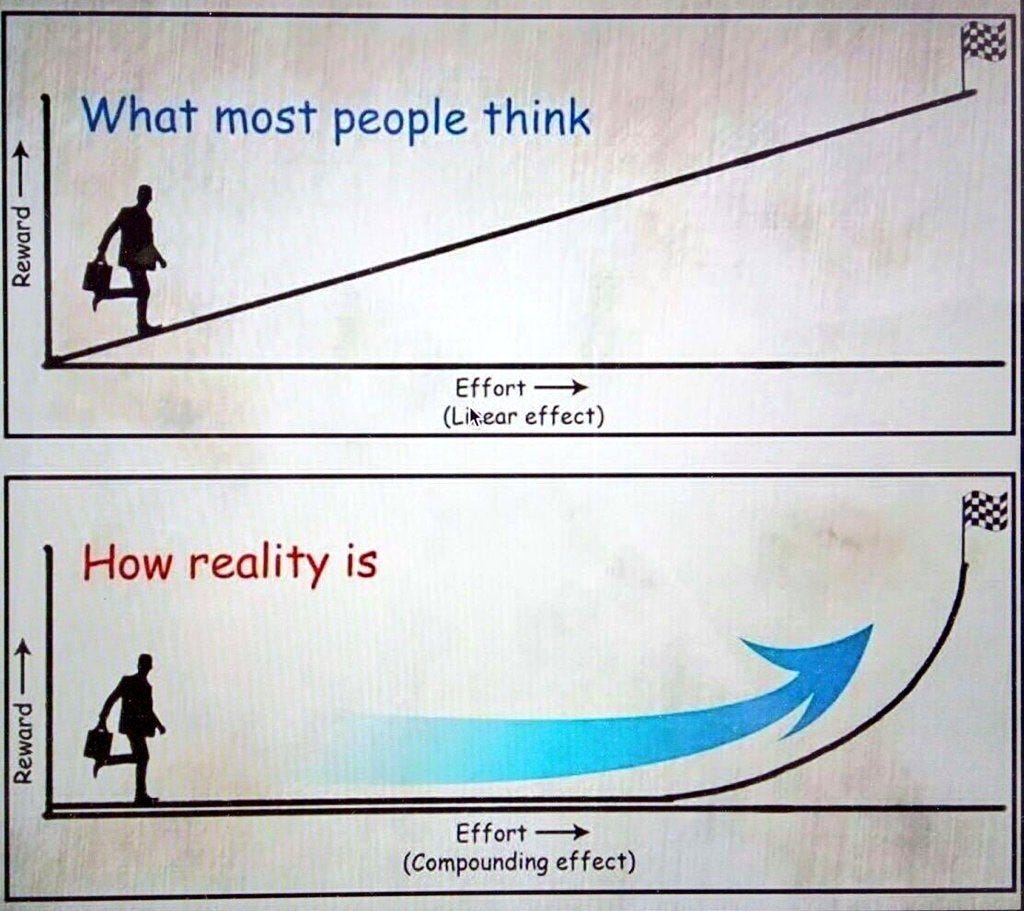
Here’s an excellent visualisation of compounding courtesy of Hamid on Twitter. Make sure to say, “thank you Hamid,” when you read this.
So we know that things like money and effort can compound, but what about ideas? what about technology? In this essay, Morgan Housel argues that the progress of the human race hinges on the compounding of ideas over time. One small idea today can become the seed of a giant leap forward for mankind given enough time to grow and be refined.
Read Morgan’s essay here.
And if you’re interested in further exploring the idea then you should watch this Ted Talk (When Ideas Have Sex is a great title by the way).
Life Lessons From Formula 1
I don’t watch Formula 1 but this essay is a storytelling masterpiece. This is not surprising because as far as storytelling goes, Charles Isidi is one of the best to ever do it.
In the essay, Charles reflects on the lessons he has learnt from spending time immersed in the world of Formula 1. And then he takes it a step further by applying some of those Formula 1 lessons to everyday life. It’s a truly delightful read and one to bookmark for the future.
Perhaps I should try writing the football version of this essay since that is the sporting world I am immersed in. We will see. In the meantime, you can read Mr Isidi’s essay here.
Reddit Vs Reddit Community
I’ve always found Reddit a pretty strange social network. It has an awful user interface, and the user experience is so bad that I wonder how people stick around and become regulars on the platform.
But there’s something else that is fascinating too: How much power lies in the hands of the Reddit communities. Reddit has given so much power to its communities that they are now effectively shareholders with a (powerful) say in the direction of the platform’s development.
A good example was the recent Reddit shutdown when the communities took the site down to protest a new policy change by the company on third-party apps. Read Casey Newton’s report covering the clash in full detail for the whole story.
But just a side note, can you imagine Zuckerberg giving, say Facebook groups so much power that they can bring the service to its knees if they don’t like some new policy? Huh? Yeah, I think not. More power to Reddit communities, please.
Thank you for reading and see you next Saturday!